
Forex market hours in UK time
Standard forex market hours UK traders follow run from 10pm on Sunday to 10pm on Friday. Trading continues 24 hours a day across 4 sessions in Sydney, Tokyo, London and New York. Your busiest daytime window is the London session from 8am to 5pm UK time.
Under standard conditions, the market closes Friday at 10pm UK time and reopens Sunday at 10pm UK time, with Christmas Day and New Year's Day
When does the forex market open and close in the UK?
Currency trading starts Sunday at 10pm UK time and runs through until Friday at 10pm UK time. Since there's no central exchange, large banks pass trading from city to city throughout the day for 24 hours on each weekday. You can trade at any hour from Sunday night through Friday night.
The market closes at 10pm on Friday for the weekend and remains shut all day on Saturday. There's also no trading on Christmas Day or New Year's Day. Other public holidays don't close the market, though some currency pairs may pause while local banks are shut.
If you keep a trade open past 10pm UK time, your broker calculates an overnight charge or credit called a swap. Many traders who operate during the day close positions before 10pm, so they don't pay this overnight cost. You can first test the daily times on a demo forex account and see how they work.
| Day or period | UK time | Market status |
|---|---|---|
| Sunday | Opens at 10pm | Trading begins as the Sydney session opens |
| Monday to Thursday | Open 24 hours | Continuous trading with daily swap calculation at 10pm |
| Friday | Closes at 10pm | The New York close brings the trading week to an end |
| Saturday | Closed all day | No weekday currency trading |
| Christmas Day and New Year's Day | Closed all day | Full market holiday closures |
Source: UK Forex Market Hours: When to Trade FX, read 2 Nov 2026; Market trading hours, read 2 Nov 2026
Forex session times in GMT and BST
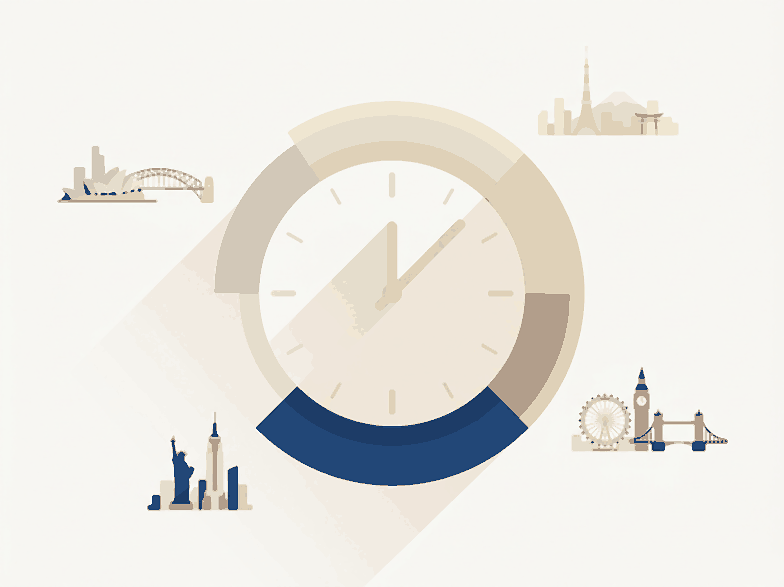
There are 4 main trading windows in the global forex market hours: Sydney, Tokyo, London and New York. UK times follow Greenwich Mean Time, or GMT, during winter. In summer, UK clocks move ahead by 1 hour and use British Summer Time, or BST.
On your UK clock, the London session forex time is 8am to 5pm throughout the year. Overseas daylight saving changes mean the other sessions shift by 1 hour between summer and winter. Local currencies are most active in each window, with pairs such as GBP/USD appearing on your screen.
| Session | Open in winter GMT | Close in winter GMT | Open in summer BST | Close in summer BST | Key currency pairs |
|---|---|---|---|---|---|
| Sydney | 10pm | 7am | 11pm | 8am | AUD/USD, NZD/USD and AUD/JPY |
| Tokyo | 12am | 9am | 1am | 10am | USD/JPY, EUR/JPY and AUD/JPY |
| London | 8am | 5pm | 8am | 5pm | EUR/USD, GBP/USD, EUR/GBP and USD/CHF |
| New York | 1pm | 10pm | 2pm | 11pm | EUR/USD, USD/JPY, GBP/USD and USD/CAD |
Since currency trading has no central opening bell, brokers sometimes publish session hours that differ slightly. Our timings follow the UK timetable published by IG. CMC Markets and Pepperstone list the London window from 8am to 4pm GMT, while Tokyo runs from 12am to 9am GMT. For Sydney, CMC Markets lists 8pm to 5am UK time. In every timetable you read, trading continues when one session ends because the next centre is already open.
Source: UK Forex Market Hours: When to Trade FX, read 2 Nov 2026; Forex market hours, read 2 Nov 2026; Forex Trading Sessions, read 2 Nov 2026; GOV.UK, read 2 Nov 2026
London session forex time and its overlap with New York
Britain leads the world as a centre for currency trading. From 8am to 5pm UK time, Britain handles 35% to 43% of worldwide volume. This heavy trading volume creates high liquidity. The number of buyers and sellers trading at any one time is called liquidity, and it helps you trade at a steady price.
High volume also narrows the spread. The spread is the small difference between your buying and selling prices, which is the cost you pay to trade. The London and New York crossover is the busiest period. It runs from 1pm to 5pm GMT in winter and from 2pm to 6pm BST in summer. The afternoon crossover represents 50% to 60% of that day's price movement.
EUR/USD can move 80 to 120 pips during the overlap, compared with 40 pips when a session runs alone. Currency exchange rates use the pip as a standard tiny unit for measuring price changes. More than 85% of all currency trades include the US dollar. Major US data usually lands between 1:30pm and 3pm UK time, before the US stock market opens in UK time at 2:30pm.
| Trading window | UK time in winter GMT | Why traders watch this window |
|---|---|---|
| Sydney and Tokyo overlap | 12am to 7am | AUD, NZD and JPY currency pairs reach peak activity overnight |
| Tokyo session | 12am to 9am | The main overnight window covers Japanese yen pairs, with USD/JPY and EUR/JPY as examples |
| London session | 8am to 5pm | EUR/USD, GBP/USD and EUR/GBP have the greatest liquidity and smallest spreads. |
| London and New York overlap | 1pm to 5pm | Both major centres operate together during the day's largest price moves. |
| US data release window | 1:30pm to 4pm | US interest rate and economic announcements affect major dollar pairs |
| Late night rollover window | 10pm to 12am | Trading has its lowest volume, widest spreads and gap risk following the Sunday open |
UK workday trading usually offers tighter spreads from 8am to 5pm than late-night trading. Between 10pm and 12am UK time, spreads widen because New York has closed and Tokyo hasn't opened.
Source: Forex market hours, read 2 Nov 2026; Forex Trading Sessions, read 2 Nov 2026; UK Forex Market Hours: When to Trade FX, read 2 Nov 2026
UK and US clock change dates and server time
The UK changes its clocks on a different Sunday from the United States. This difference shifts afternoon trading times by 1 hour for a period. On the final Sunday of March at 1am, UK clocks move forward 1 hour to begin BST. On the final Sunday of October at 2am, UK clocks move back 1 hour and GMT returns.
In the United States, daylight saving starts at 2am local time on the second Sunday of March. The first Sunday of November brings an end to daylight saving at 2am local time. The mismatch happened twice in 2026, from 8 March to 29 March and from 25 October to 1 November. On your UK clock, the New York session appears 1 hour earlier in those weeks, as do any US data releases.
| Year | UK clocks go forward 1 hour at 1am | UK clocks go back 1 hour at 2am |
|---|---|---|
| 2026 | 29 March | 25 October |
| 2027 | 28 March | 31 October |
| 2028 | 26 March | 29 October |
You'll also see a different clock on many spread betting and CFD apps. At Pepperstone, platform server time uses GMT+3 from March to November and GMT+2 from November to March. Brokers configure this so daily price charts end at 10pm UK time, at the same time as the New York session.
Source: Market trading hours, read 2 Nov 2026.; Daylight Saving Time, read 2 Nov 2026.; GOV.UK, read 2 Nov 2026.; NIST, read 2 Nov 2026.; UK Forex Market Hours: When to Trade FX, read 2 Nov 2026.
Common questions answered
What time does forex trading start in the UK on Sunday?
At 10pm on Sunday, UK trading begins as banks in Australia and New Zealand start their Monday morning. Between 10pm and 12am, prices may move sharply as low trading volume combines with the market pricing in weekend news at once.
Is forex trading available today?
The market opens every weekday. Full closures occur only on Saturdays, Christmas Day and New Year's Day. Trading peaks midweek, while volume falls on Friday afternoon as European and Asian traders slow down ahead of the weekend.
When does the forex market open today in the UK?
Overnight trading at financial centres in Tokyo, China, Australia, New Zealand and Russia means the market is already active by morning on any weekday. As Europe starts, late Asian trading overlaps with it. UK traders therefore see activity increase between 7am and 8am GMT. During the European lunch window, trading often slows again between 12pm and 2pm GMT.
What are the 4 forex trading sessions?
The 4 forex sessions are Sydney, Tokyo, London and New York. Each window also includes a wider group of nearby countries. The Asian session covers Tokyo, Sydney, China, Australia, New Zealand and Russia, the European session includes London, Germany and France. Coverage by the North American session extends through the United States, Canada, Mexico and South America.
More pages to read
- London session forex time (guide)
- US stock market open in UK time (guide)