
Day trading tax in the UK
Under day trading tax UK rules, almost everyone trading shares or contracts for differences pays Capital Gains Tax. You only pay Income Tax if HMRC decides you're running a business trade. Spread betting profits are normally tax-free, though you can't claim tax relief on losses.
in almost every case TCGA92/S143 puts the results under the capital gains regime, unless the profits count as taxable trading income
Which tax applies to your day trading, Capital Gains Tax or Income Tax?
Most people pay Capital Gains Tax rather than Income Tax on their net profits. With a broker, a contract for differences (a CFD) settles in cash the price change of an asset. You don't own the actual share or currency involved. Unless your profits are business trading income, HMRC applies the capital gains rules to retail CFDs in almost every case.
Closing a CFD combines all credits and debits on your account into one calculation of capital gains or losses. This covers broker commission and any daily financing charges or dividend adjustments. Those adjustments don't appear as investment income in your return, since interest and company dividends never actually change hands. If you trade CFDs against stocks, you avoid stamp duty reserve tax, unlike direct share purchases.
The annual tax-free allowance comes off first, then Capital Gains Tax applies to the rest of your total gains. For an individual, the allowance is £3,000; for a trust, it's £1,500. Deducting allowable losses from your gains can also reduce your tax bill.
| Way you trade | Normal UK tax treatment | Annual tax-free allowance | Can you deduct losses? |
|---|---|---|---|
| CFDs and shares as an investor | Capital Gains Tax | £3,000 for individuals or £1,500 for trusts | Yes, allowable losses can reduce your gains |
| Spread betting | Taxed as betting, not trading | No limit on tax-free profits for most people | No, you get no relief for losses |
| Trading classed by HMRC as a business trade | Income Tax on trading income | Up to £1,000 trading allowance instead of expenses | Yes, loss relief can be claimed on a tax return |
Source: HMRC's internal manual, accessed 2 Nov 2026.; GOV.UK, accessed 2 Nov 2026.; HMRC's internal manual, accessed 2 Nov 2026.; GOV.UK, accessed 2 Nov 2026.
Tax on spread betting and day trading
Profits from spread betting normally don't attract Capital Gains Tax or Income Tax. With spread betting, you bet on whether a market price rises or falls, without buying the asset. UK tax law doesn't treat betting and gambling as carrying on a trade.
HMRC views you as placing a bet, so your wins are tax-free. Instead, tax on business profits falls on the bookmaker who organises the spread bet. One drawback of spread betting versus CFDs is that you can't claim tax relief for losses.
The exception applies only when your spread betting wins come directly from an existing trade you carry on. Merely having a trade that gave you a chance to place a bet isn't enough. HMRC reviews the contract terms alongside the economic reality of your activity.
Source: HMRC internal manual, checked 2 Nov 2026; HMRC internal manual, checked 2 Nov 2026.
Might HMRC treat your day trading as a trade?
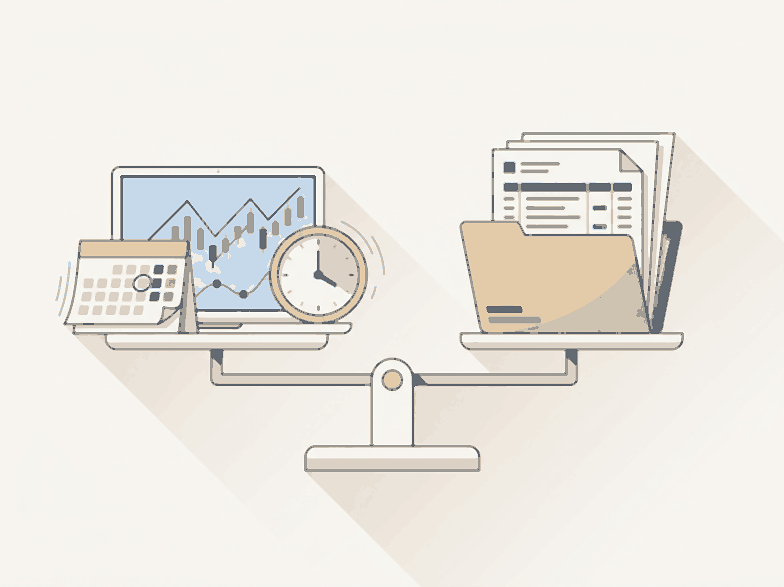
To judge if you're running a business trade, HMRC and the courts weigh up the impression your activity creates overall. Income Tax is payable under day trader tax UK rules only if the facts all point to you carrying on a trade. A daytime job doesn't prevent evening activity from counting as a business.
We judge each case against the pointers that HMRC and the courts call badges of trade. One badge alone doesn't settle the question. Seeking profit, making repeated transactions and selling assets quickly can all point towards trading. HMRC still considers each badge against your exact circumstances.
| Badge of trade | What HMRC looks at |
|---|---|
| Profit-seeking motive | Wanting to make a profit points towards trading, though on its own it doesn't decide the matter. |
| Number of transactions | Systematic and repeated transactions point towards a trade |
| Nature of the asset | Whether the asset gives you a benefit only once you sell it, instead of paying income or bringing personal enjoyment to you. |
| Similar trading interests | Deals that fit with a trade you already run are more likely to count as a trade. |
| Changes to the asset | Improving or modifying an asset so it sells more easily or for more profit |
| Way the sale is carried out | Selling the way a trading business normally does, rather than raising cash for an emergency |
| Source of finance | Taking out a loan to buy the asset when selling it is the only way you can repay that loan |
| Time between buying and selling | Holding an asset long term is less of a sign of trading than planning to sell it soon after buying. |
| Method of acquisition | When an asset is inherited or given to you, it's less likely to be the subject of trading. |
Some badges don't fit financial markets such as forex trading or prop firm trading. While some badges may point towards a trade, others may point away from one. If you're unsure whether your activity counts as trading, contact HMRC for advice.
Source: HMRC's internal manual, accessed 2 Nov 2026.; GOV.UK, accessed 2 Nov 2026.
Self Assessment: reporting your day trading profits
A Self Assessment tax return is required where you owe Capital Gains Tax for the year in question. In the UK, the tax year starts on 6 April and ends on 5 April. Self-employed sole traders with earnings above £1,000 before expenses must also send a return.
Instead of deducting expenses, people with trading income can use a tax-free trading allowance worth up to £1,000 each year. When your gross trading income comes to £1,000 or less, you usually don't need to notify HMRC of it. Registration is still needed to claim a loss on your return, or to pay National Insurance voluntarily.
These are the main steps for reporting your day trading for the tax year:
- HMRC may charge a penalty for poor records, so your records of statements and trades must be accurate, complete and readable.
- When you need to send a return, sign up for Self Assessment by 5 October, once the tax year has ended.
- Submit a return with net capital gains, or with trading income after taking the £1,000 allowance or expenses claimed.
This gives general information on the tax rules, but it isn't tax advice.
Sources: GOV.UK, accessed 2 Nov 2026.; GOV.UK, accessed 2 Nov 2026.
Common questions answered
Do I owe tax if I day trade in the UK?
Yes, tax applies if your overall gains for the tax year exceed the £3,000 allowance, whether you trade shares or CFDs. That covers going long to gain from a rising price and going short to gain from a falling price, once the contract is closed.
Is spread betting free from tax in the UK?
Because UK courts treat someone placing bets as gambling rather than as running a business, spread betting is free of tax for most UK residents. Rather than taxing you, HMRC taxes the firms offering spread betting, which act as the bookmaker.
In the UK, is forex trading tax-free?
Your broker contract determines whether forex trading in the UK is tax-free. A normal punter pays no Capital Gains Tax and no Income Tax on forex spread bets. With forex CFDs, Capital Gains Tax applies once your yearly gains pass £3,000.
Is tax owed when you trade gold?
Day trading gold with a cash-settled CFD based on price movements means HMRC taxes your net gains. That charge is Capital Gains Tax, and it applies to gains above the £3,000 allowance. With a spread bet on gold, your profits aren't taxed unless they come from a trade you were already carrying on.
More pages to read
- Forex trading tax in the UK (guide)
- CFD tax in the UK (guide)
- Spread betting tax in the UK (guide)
- Is spread betting tax free? (guide)
- Is forex trading tax free in the UK? (guide)
- Prop firm tax in the UK (guide)